IASTM (INSTRUMENT ASSISTED SOFT TISSUE MOBILISATION) CPD COURSE
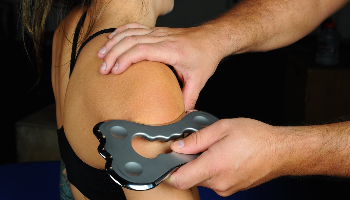
Instrument assisted soft tissue mobilisation is used during deep tissue and sports massage where deemed apppropriate. It is a pro-inflammatory treatment involving the use of tools in a scraping motion, to assess tissue quality and expedite healing in the soft tissues by releasing scar tissue, adhesions and other restrictions, treating chronic inflammation, improving alignment and length of muscle fibres, improving range of motion, coordination and muscle activation, stimulating fibroblast production and promoting circulation.
IASTM can benefit tendinopathies, plantar fasciitis, neck and back pain, ITB syndrome, sprains and strains, myofascial restrictions and post-surgical scarring
Practical session in Tunbridge Wells
This course combines well with:-
Deep Tissue Practical Session
COURSE CONTENT & OVERVIEW
Legislation
Professional Code of Conduct
Introduction to IASTM
Application and Benefits
Physiological responses
Types of Tools
Techniques
Precautions and Contraindications
Fascia
Trigger Points
Clinical Patterns
- Upper body
- Lower body
Case Study
Tools Available
Suggested Treatment Strokes
- For upper body
- For lumbar and hip
- For thigh and leg
- For calf and foot
COST:£200
DURATION:theory at your own pace and half day practical session in Tunbridge Wells
PREREQUISITES: Sports Massage Diploma, Level 3 Anatomy and Physiology
This course is intended for anyone who has already undertaken a sports massage course training:-
• and would like to develop their skillset, incorporating targeted use of IASTM to work more deeply on clients with higher levels of tension
CPD POINTS: 10
LEARNING OUTCOMES
• to select specific tools, techniques and treatment plans for clinical conditions
• compare mechanical and physiological responses of IASTM
• explain the difference between a fascial restriction and muscle tightness
• identify indications and contraindications of IASTM
• to explain the reasoning behind IASTM
• to understand how to identify common fascial restrictions
• to differentiate between spinal stenosis, spondylosis and lumbar radiculopathy
• to differentiate between active and latent trigger points
ASSESSMENT
Theory assessment only - The overall pass mark must exceed 70%. If the mark is lower, a retake is available free of charge.
QUALIFICATION
IASTM accredited by the IGCT will act as an addition to your CPD.